

Many facility managers have been there: a new commercial cleaning company looks great on paper, passes the initial walkthrough, and then quietly underdelivers within two months. Missed tasks pile up, turnover on the cleaning crew makes consistency impossible, and the contract language offers no real recourse. The real cost of that scenario goes well beyond a messy lobby. It includes liability exposure from inadequate disinfection, potential increases in employee sick days, and the operational drag of managing a vendor who isn’t performing.
Choosing the right commercial cleaning company is a risk management decision, not just a facilities task.
When you treat it that way, you ask better questions, read contracts more carefully, and avoid the vendors who rely on low bids and vague promises.
This article gives you a structured way to evaluate janitorial service providers you consider: what they should bring to the table, how requirements differ by facility type, which credentials actually matter, what to ask before you sign, and what a solid service agreement looks like.
What a professional commercial cleaning company actually brings to the table
Before you can compare vendors, you need to understand what separates a qualified commercial cleaning operation from a general contractor or solo cleaner. The structural differences matter far more than the price at the bottom of a quote sheet.

Trained staff, industrial equipment, and documented protocols
Professional commercial cleaners operate with HEPA or industry-standard filtration equipment where appropriate, EPA-registered disinfectants, and task-specific protocols for each zone in a facility. This isn’t about mopping harder or more often. It’s about trained staff following repeatable, documented systems, the kind that reduce liability and produce consistent results visit after visit. When a protocol exists in writing and staff are trained to it, you get defensible cleanliness rather than cleanliness that depends entirely on who showed up that day.
Scalability and multi-location coordination
Multi-location businesses need a commercial janitorial services partner who can deploy consistent standards across all sites without the client managing separate vendors for each building. Top-tier providers use a master services agreement that sets portfolio-wide standards, then add site-specific schedules for each location’s square footage, frequency, and special requirements. Dedicated account managers, standardized onboarding, and portfolio-wide reporting are what make that model work.
Accountability structures that protect your business
A credentialed facility cleaning company brings audit trails, inspection reports, and defined escalation paths when service falls short. Contrast that with an informal arrangement where there’s no documented quality control, no incident reporting, and no recourse when standards slip. Without those accountability structures, you’re relying entirely on goodwill, and goodwill doesn’t hold up when a client or regulatory inspector walks through the door.
How cleaning requirements differ across facility types
Generic cleaning advice doesn’t help a healthcare administrator or a school facilities director make a real decision. Each environment carries distinct demands, and the vendor you choose needs to understand yours before they submit a proposal.
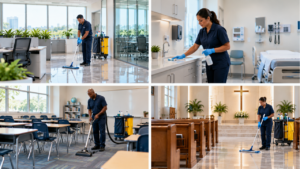
Corporate office environments: employee health and client impressions
In a corporate setting, a professional office cleaning company maintains the touchpoints that shape how clients and employees experience your space: lobbies, conference rooms, restrooms, and common areas.
Consistent cleanliness at those points can reduce sick days, limit absenteeism, and signal to clients that your organization is well-run. After-hours scheduling, high-touch surface protocols, and flexible frequency options are the practical tools that make that possible without disrupting your team’s workday.
Healthcare and educational facilities: stricter disinfection protocols
Healthcare cleaning requires CDC-aligned disinfection of clinical surfaces, documented bloodborne pathogen protocols, and demonstrable compliance with infection-control standards. This is not a category where you can accept vague assurances about “hospital-grade” products.
Corporate Cleaning Group’s healthcare cleaning services use EPA-registered disinfectants, trained cleaning teams, and documented quality-control procedures designed for the specific needs of healthcare facilities.
Educational facilities face a different challenge: constant, unpredictable traffic that makes keeping campuses clean a moving target. Scalable scheduling and rapid-response protocols are what keep schools functional and safe throughout the academic year.
Religious and high-use communal spaces: reliability under demand
Churches, synagogues, mosques, and other religious facilities experience compressed, high-traffic use followed by strict preparation windows before the next service or event. A dependable commercial cleaning partner adapts to that rhythm, covering deep restroom sanitation, pew and seating areas, and kitchen facilities on tight turnarounds.
Corporate Cleaning Group’s experience with religious venue cleaning reflects this kind of operational flexibility: showing up when it counts, completing the scope on time, and doing it reliably week after week.
The credentials and compliance standards worth verifying
Don’t hire a vendor based on a logo on their website. These are the specific documents and certifications to request before any contract conversation gets serious.
Insurance and bonding: the baseline before everything else
Any commercial cleaning vendor you consider should carry general liability insurance and workers’ compensation, and you should require proof of both before discussions go further. General liability covers property damage and third-party bodily injury claims; workers’ comp covers employees injured on your premises. Requirements vary by jurisdiction, so verify what’s legally mandated in your area, but treat these coverages as your minimum threshold regardless. A certificate of insurance is the minimum acceptable proof; a verbal confirmation is not.
Bonding adds an additional layer of protection against theft or dishonesty by cleaning staff, and reputable firms carry it as a standard part of their offering.
OSHA compliance and chemical handling standards
A reputable janitorial contractor trains staff on hazard communication, proper PPE use, chemical dilution, and bloodborne pathogen procedures. For healthcare or food-service environments, sector-specific training, including infection-control and HACCP protocols, is an additional requirement.
Ask for the company’s written safety program, not just a statement that they’re “OSHA compliant.” A company that hands you a documented safety program without hesitation has the operational depth you need.
Important questions to ask before you hire a commercial cleaning company
These aren’t generic checklist items. They’re the specific questions that reveal whether a vendor has real operational depth or is improvising at scale. These questions can also help you compare commercial janitorial services before committing to a provider.
1. Scope, staffing, and supplies: what the quote actually covers
Start with the basics:
Which tasks are included?
Are supplies and equipment provided, or billed separately?
Does the vendor use in-house staff or subcontractors?
What’s the backup plan if a cleaner is absent?
Vendors who use subcontractors introduce a layer of variability that makes consistent quality harder to enforce and accountability harder to establish. A vendor who answers the absence question with a specific protocol, not a vague assurance, has thought through operational continuity.
2. Contract terms, pricing changes, and cancellation rights
These are the questions most businesses skip until it’s too late.
What’s the minimum contract term?
How much written notice is required to cancel?
When and by how much can pricing change?
Are there early-termination fees?
A trustworthy commercial cleaning partner answers these questions clearly upfront without burying the details in fine print. If a vendor deflects or hedges on any of them, take that seriously before signing anything.
3. Quality control, inspections, and performance recovery
Ask how the vendor handles a missed or substandard clean:
Is there a re-clean guarantee?
How quickly do they respond?
Who conducts quality inspections, and how often?
What’s the escalation path if the same issue recurs?
Vendors worth shortlisting answer these questions with specific processes, not general statements about caring about quality. The difference between “we take quality seriously” and “our account managers conduct bi-weekly inspections against a standardized scorecard with a defined remediation window, such as 24 to 72 hours, for any deficiencies” tells you everything.
What a strong service agreement looks like before you sign
The service agreement is where vendor promises become enforceable expectations. Most facility managers underinvest in reviewing this document, and it costs them later.

Scope of work and explicit exclusions
A well-written scope of work names every room, task, and frequency in the agreement. It also lists what’s excluded, because ambiguity around windows, specialty floors, or periodic deep cleaning is exactly where disputes start. A zone-by-zone task schedule attached as an appendix protects both parties and eliminates the “I thought that was included” conversation six months into the contract.
KPIs and service-level standards
More sophisticated commercial cleaning agreements define measurable performance standards: inspection pass rates, response times for complaints, and remediation steps tied to specific outcomes. The most enforceable KPIs have clear thresholds and corrective-action triggers, a minimum inspection pass rate, a task completion rate close to 100% for routine scope, and a complaint response time measured in hours rather than “as soon as possible.” If a vendor can’t define what good service looks like in measurable terms, that’s a signal worth taking seriously before you commit.
Termination clauses, notice periods, and exit protections
Most commercial cleaning contracts allow termination with 14 to 30 days’ written notice. Fixed-term agreements should include a performance-based exit clause so you’re not locked in if service quality deteriorates despite documented complaints and remediation attempts.
Corporate Cleaning Group works with prospective clients to understand their facility’s needs and develop a customized cleaning plan, giving businesses a clear picture of the services required before getting started.
Making the right call for your facility
The vendor you select will either protect or add to your operational risk, and the difference almost always comes down to how carefully you vetted them upfront.
Reviewing credentials, understanding pricing, asking hard questions, and reading the contract carefully are not administrative formalities. They’re what separate a reliable commercial cleaning company from a problem vendor you’ll be managing for the next year.
The five areas that matter most are service scope, facility-specific standards, verified credentials, transparent pricing, and a solid contract with enforceable protections. Get clarity on all five before you sign anything, and you’ll avoid the disruptions that make poor janitorial hires so costly in practice.
If you’re evaluating vendors right now, use the questions in this article as your benchmark. Request a quote from a commercial janitorial services partner who can answer every one of them clearly, without hesitation.
If you’d like to see what that looks like in practice, reach out to our team at Corporate Cleaning Group. We’ll walk you through our scope, credentials, and contract terms without reservation, that transparency is the standard we hold ourselves to throughout every engagement.